Loading...
Searching...
No Matches
ssd130x.c File Reference
Source file with implementation of SSD130X display driver functions. More...
#include "ssd130x.h"
Include dependency graph for ssd130x.c:

Functions | |
| void | ssd130x_init (void) |
| Initializes the SSD130X display. | |
| void | ssd130x_disable (void) |
| Disables the TWI interface used for SSD130X communication. | |
| void | ssd130x_position (unsigned char column, unsigned char page) |
| Sets the current write position on the SSD130X display. | |
| void | ssd130x_scroll_vertical (unsigned char scroll) |
| Scrolls the SSD130X display vertically by a specified offset. | |
| void | ssd130x_frame (unsigned char *frame) |
| Displays a full frame (all pages) of pixel data on the SSD130X. | |
| void | ssd130x_page (unsigned char *data, unsigned char page) |
| Writes a full page of pixel data to the SSD130X display. | |
| void | ssd130x_page_segment (unsigned char *data, unsigned char column_start, unsigned char column_stop, unsigned char page) |
| Writes a segment of pixel data to a specific page on the SSD130X display. | |
| void | ssd130x_column (unsigned char data, unsigned char column, unsigned char page) |
| Writes a single byte of pixel data to a specific column and page on the SSD130X display. | |
| void | ssd130x_clear (void) |
| Clears the entire SSD130X display. | |
| void | ssd130x_clear_page (unsigned char page) |
| Clears a single page of the SSD130X display. | |
| void | ssd130x_clear_page_segment (unsigned char column_start, unsigned char column_stop, unsigned char page) |
| Clears a specific segment of a page on the SSD130X display. | |
| void | ssd130x_clear_column (unsigned char column, unsigned char page) |
| Clears a single column within a specified page on the SSD130X display. | |
Variables | |
| const unsigned char ssd130x_init_commands[] | EEMEM |
| unsigned char | column_current_position |
| unsigned char | page_current_position |
Detailed Description
Source file with implementation of SSD130X display driver functions.
This file contains the initialization and control functions for the SSD130X display using TWI (I2C) communication, supporting both software and hardware TWI interfaces. It includes functions for sending commands and data to the display, positioning, scrolling, clearing, and updating display memory pages and segments.
- Note
- The SSD130X initialization routine commands are stored either in EEPROM or program memory, controlled by the SSD130X_INIT_ROUTINE_IN_EEPROM macro.
Communication with the SSD130X is abstracted through macros that select software or hardware TWI implementations based on compile-time configuration.
- Date
- 2026-07-17
- Version
- 1.0 Release
- Copyright
- Copyright (c) 2026 g.raf Released under the GPLv3 License. (see LICENSE in repository)
- Note
- This file is part of a larger project and subject to the license specified in the repository. For updates and the complete revision history, see the GitHub repository.
- See also
- https://github.com/0x007e/drivers-display-ssd130x "SSD130X Display Driver GitHub Repository"
Function Documentation
◆ ssd130x_clear()
| void ssd130x_clear | ( | void | ) |
Clears the entire SSD130X display.
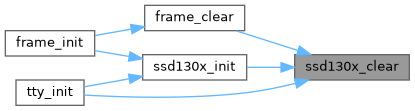
This function iterates through all display pages and clears each one by calling ssd130x_clear_page. After clearing all pages, it resets the cursor position to the home position (0,0) using SSD130X_HOME.
- Note
- This effectively resets the display content, turning off all pixels.
Here is the call graph for this function:

Here is the caller graph for this function:
◆ ssd130x_clear_column()
| void ssd130x_clear_column | ( | unsigned char | column, |
| unsigned char | page ) |
Clears a single column within a specified page on the SSD130X display.
- Parameters
-
column The column index (horizontal position) to clear. page The page index (vertical position in groups of 8 pixel rows) where the column resides.
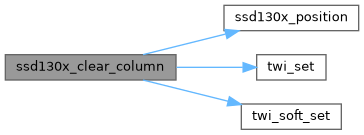
This function sets the cursor to the specified column and page, then writes a single zero byte to turn off all pixels in that column for the specified page. Communication with the display is done via TWI, using start and stop conditions, and the data control byte.
- Note
- Clearing a column effectively resets the pixels in that vertical segment to off.
Here is the call graph for this function:
◆ ssd130x_clear_page()
| void ssd130x_clear_page | ( | unsigned char | page | ) |
Clears a single page of the SSD130X display.
- Parameters
-
page The page index (0-based) to clear. Must be less than SSD130X_ROW_SIZE/SSD130X_PAGE_SIZE.
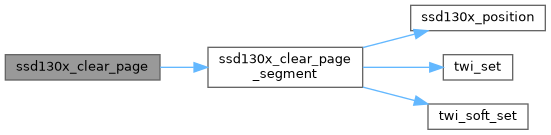
This function clears all columns within the specified page by calling ssd130x_clear_page_segment with the full column range from 0 to SSD130X_COLUMN_SIZE - 1.
- Note
- It turns off all pixels on that page, effectively wiping the displayed content in that segment.
Here is the call graph for this function:
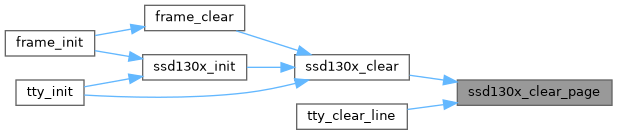
Here is the caller graph for this function:
◆ ssd130x_clear_page_segment()
| void ssd130x_clear_page_segment | ( | unsigned char | column_start, |
| unsigned char | column_stop, | ||
| unsigned char | page ) |
Clears a specific segment of a page on the SSD130X display.
- Parameters
-
column_start The starting column index of the segment to clear (inclusive). column_stop The ending column index of the segment to clear (inclusive). page The page index (0-based) on which the segment is located. Must be less than SSD130X_ROW_SIZE/SSD130X_PAGE_SIZE.
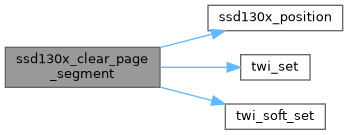
This function clears a horizontal segment of a specified page by writing zeroes (turning off pixels) to the display RAM across the specified column range. It first validates the input parameters to ensure they are within the display boundaries and that column_start is less than or equal to column_stop. After setting the cursor position to the start column of the specified page, it sends a series of zero bytes over the TWI interface to clear each column in the segment. Communication starts with a start condition and a control byte indicating data transmission, and ends with a stop condition.
Here is the call graph for this function:
Here is the caller graph for this function:

◆ ssd130x_column()
| void ssd130x_column | ( | unsigned char | data, |
| unsigned char | column, | ||
| unsigned char | page ) |
Writes a single byte of pixel data to a specific column and page on the SSD130X display.
- Parameters
-
data The byte of pixel data to write; each bit represents a pixel in the vertical column. column The column index (horizontal position) where the data should be written. page The page index where the data should be written.
- Note
- Both column and page must be within the display bounds (SSD130X_COLUMN_SIZE and SSD130X_ROW_SIZE/SSD130X_PAGE_SIZE respectively).
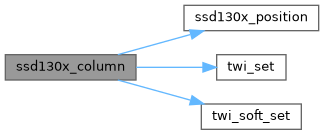
This function updates the pixel data of one specific column within a specified page. It first verifies that the target page and column are valid. Then, it sets the SSD130X cursor to the specified position and sends the pixel data byte via TWI. Communication begins with a start condition and a control byte indicating data transmission, followed by the data byte, and ends with a stop condition.
Here is the call graph for this function:
Here is the caller graph for this function:

◆ ssd130x_disable()
|
inline |
Disables the TWI interface used for SSD130X communication.
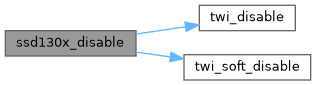
This inline function disables the TWI (I2C) peripheral or software interface used to communicate with the SSD130X display, depending on whether software or hardware TWI is enabled. It is used to safely release TWI resources when SSD130X communication is no longer required, helping to reduce power consumption or prevent bus contention.
Here is the call graph for this function:
◆ ssd130x_frame()
| void ssd130x_frame | ( | unsigned char * | frame | ) |
Displays a full frame (all pages) of pixel data on the SSD130X.
- Parameters
-
frame Pointer to an array containing pixel data for the entire display, organized as consecutive pages.
This function updates the entire SSD130X screen by sequentially writing data page by page. It first resets the current cursor position to the home position (0,0), then iterates over all pages, calling ssd130x_page to write each page’s data.
- Note
- The frame parameter should contain SSD130X_PAGE_SIZE pages of pixel data, where each page holds pixel data for the full width of the display.
Here is the call graph for this function:

◆ ssd130x_init()
| void ssd130x_init | ( | void | ) |
Initializes the SSD130X display.
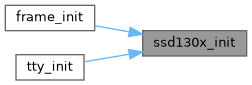
This function initializes the TWI (I2C) communication interface to the SSD130X display, supports both software and hardware TWI based on compile-time configuration. It then sends a predefined sequence of initialization commands stored either in EEPROM or program memory to configure the SSD130X hardware registers and settings. After sending the initialization commands, the communication is ended with a stop condition, and the display is cleared to prepare it for use.
- Note
- This function must be called once during system startup before any display operations.
Here is the call graph for this function:

Here is the caller graph for this function:
◆ ssd130x_page()
| void ssd130x_page | ( | unsigned char * | data, |
| unsigned char | page ) |
Writes a full page of pixel data to the SSD130X display.
- Parameters
-
data Pointer to an array containing pixel data for one display page. page The page index (0-based) to which the data should be written. Must be less than SSD130X_ROW_SIZE/SSD130X_PAGE_SIZE.
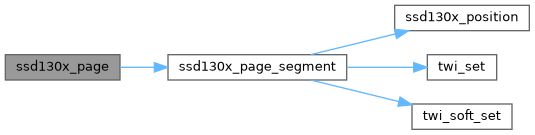
This function writes pixel data to a complete page (horizontal row of 8 pixel rows) on the SSD130X display. It performs boundary checking on the page parameter; if the page is invalid, the function returns without action.
- Note
- Internally, it calls ssd130x_page_segment to update the entire width of the display on the specified page, passing the full column range from 0 to SSD130X_COLUMN_SIZE - 1.
Here is the call graph for this function:
Here is the caller graph for this function:

◆ ssd130x_page_segment()
| void ssd130x_page_segment | ( | unsigned char * | data, |
| unsigned char | column_start, | ||
| unsigned char | column_stop, | ||
| unsigned char | page ) |
Writes a segment of pixel data to a specific page on the SSD130X display.
- Parameters
-
data Pointer to an array containing pixel data for the segment to write. column_start The starting column index of the segment (inclusive). column_stop The ending column index of the segment (inclusive). page The page index (0-based) where the data should be written. Must be less than SSD130X_ROW_SIZE/SSD130X_PAGE_SIZE.
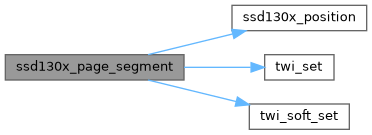
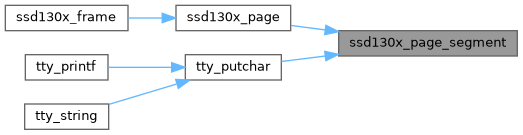
This function writes a horizontal segment of pixel data on a specified page of the SSD130X display. It first validates the input parameters to ensure the page and column ranges are within the display bounds, and that the column start is less than the column stop.
The display cursor is set to the starting column and page before data transmission. Data bytes are then sent sequentially to the SSD130X over the TWI interface, using either software or hardware TWI accordingly. Communication begins with a start condition and control byte indicating data transmission, and ends with a stop condition.
Here is the call graph for this function:
Here is the caller graph for this function:
◆ ssd130x_position()
| void ssd130x_position | ( | unsigned char | column, |
| unsigned char | page ) |
Sets the current write position on the SSD130X display.
- Parameters
-
column The column index (horizontal position) to set, must be less than SSD130X_COLUMN_SIZE. page The page index to set, must be less than SSD130X_ROW_SIZE/SSD130X_PAGE_SIZE.
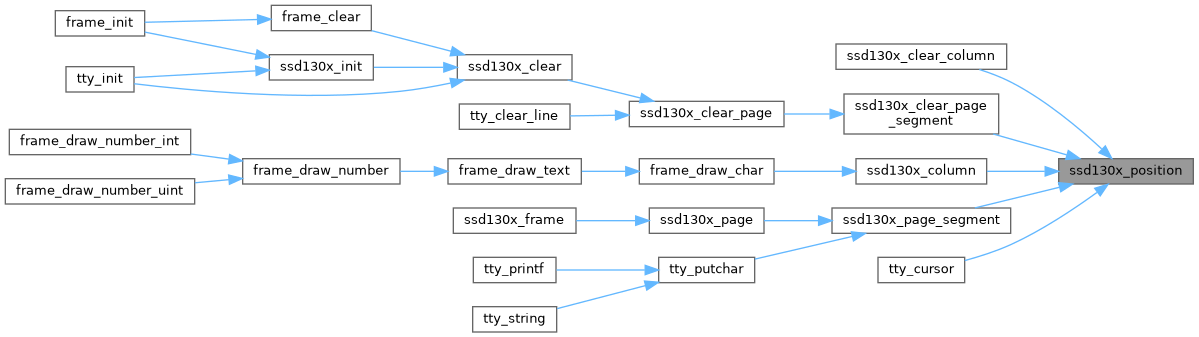
This function updates the internal tracking variables column_current_position and page_current_position to the specified values and sends the corresponding commands to the SSD130X controller to set the memory addressing position for subsequent pixel data writes. It sends commands to set the page start address and the lower and higher nibbles of the column start address. Communication is done over the TWI interface in write mode.
- Note
- If the requested position exceeds display bounds, the function does nothing.
Here is the caller graph for this function:
◆ ssd130x_scroll_vertical()
| void ssd130x_scroll_vertical | ( | unsigned char | scroll | ) |
Scrolls the SSD130X display vertically by a specified offset.
- Parameters
-
scroll The number of pixel rows to offset the display vertically. Must be less than SSD130X_ROW_SIZE to be valid.
This function adjusts the vertical display offset by sending the appropriate command and data to the SSD130X controller via TWI interface. It effectively shifts the visible area of the display vertically by the specified number of pixel rows, creating a scrolling effect.
- Note
- If the scroll value is equal to or exceeds the maximum row size, the function does nothing.
Variable Documentation
◆ column_current_position
| unsigned char column_current_position |
◆ EEMEM
| const unsigned char ssd130x_init_commands [] EEMEM |
◆ page_current_position
| unsigned char page_current_position |